
How to prepare a workplace first aid training day
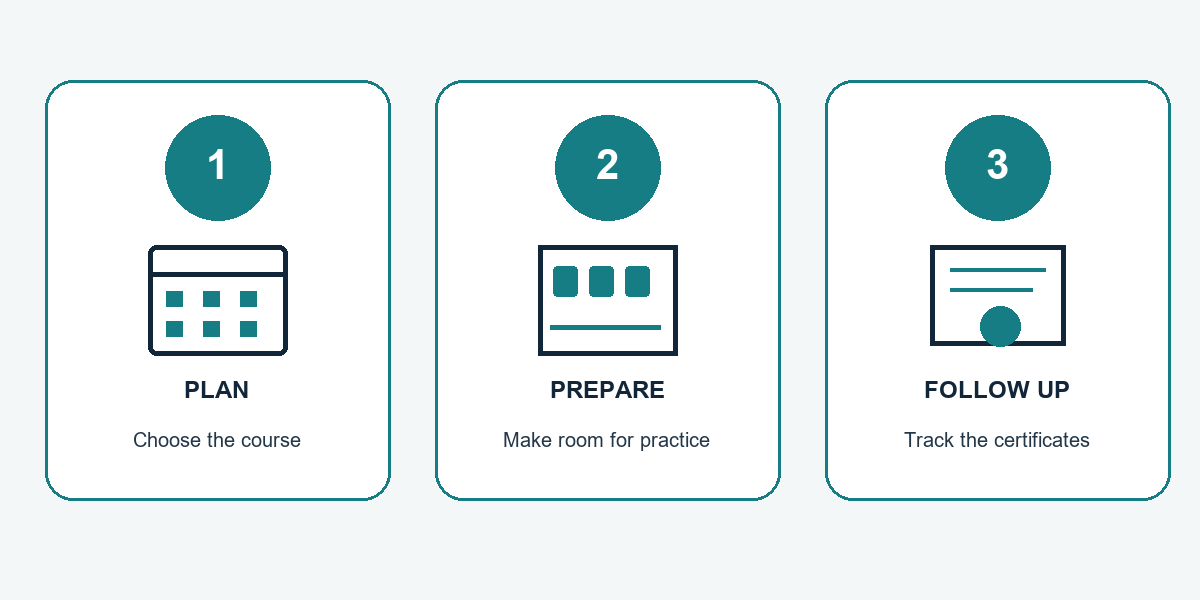
A good training day starts before anyone enters the room: confirm what credential the organization actually needs, choose people who can attend without leaving a shift uncovered, agree on a suitable course and instructor, and give learners clear arrival instructions. Then keep the teaching time free for practice rather than solving venue and roster problems on the spot.
First, settle the course question
Ask whoever set the requirement—your safety lead, employer, contract administrator or licensing body—for the exact course, certificate issuer, jurisdiction and deadline. CPR alone is not the same as a workplace first aid certificate. For a Québec employer seeking designated workplace first aiders, the CNESST says the training must come from a CNESST-recognized organization. For an Ontario workplace under WSIB rules, WSIB directs employers to its approved-provider pathway. Do not assume that any general CPR or Red Cross course automatically fills either role.[1][2]
Make a list of who is currently trained, when their certificates expire and which work periods need coverage. A single team session is useful, but it does not by itself establish that the right first aider is available whenever work is under way. CNESST discusses presence of designated first aiders and employer obligations; WSIB's first-aid program explains Ontario coverage and provider selection.[1][2] If your purpose is general team confidence rather than a mandated credential, say so in the request; it changes the course conversation, not the need to take the practice seriously.
Copy this organizer checklist
| When | What to prepare | What to confirm with the provider |
|---|---|---|
| Before requesting a date | Exact requirement and province; learner count, shift pattern, preferred language, accessible venue or off-site preference | Course name, issuer and whether that specific pathway is acceptable to your organization |
| Once a date is discussed | Names or headcount by shift, a coordinator, backup coverage, room access and any reasonable accommodation requests | Confirmed session time, instructional hours, breaks, equipment and room needs, learner prerequisites |
| Before the session | Arrival instructions, parking/transit, food and break plan, roster spelling and contact method | Who brings practice equipment and materials; what each learner must bring; how changes are handled |
| Afterward | Attendance and certificate follow-up, expiry reminders, revised coverage plan | Completion requirements and how/when certificates are issued; what to do if someone misses part of the course |
This is a planning aid, not a statutory checklist. For example, a warehouse running two shifts might nominate learners from each shift and plan temporary cover while they train; a small office might first discover that its client contract asks for a different certificate than the one it had in mind. In both cases, clarify the credential before reserving a training room.
Make practice possible—not just attendance
Choose a quiet room where learners can see and hear the instructor, move around practice stations, and reach the floor if the course includes CPR practice. Ask the provider about its actual space, accessibility, ventilation and equipment requirements rather than assuming a universal room size. Set aside the full agreed instructional window, not just a meeting slot between regular tasks. A small class does not automatically mean a shorter course; confirm the required teaching hours, format and practice time with the instructor.
Send a simple note to participants: exact location and start time, expected course length, practical-clothing suggestion if the instructor agrees, any online prerequisite only if confirmed for that course, and a contact for access needs. Do not collect diagnoses or sensitive medical history in a general roster. Eligible renewal learners may attend the same class as first-time learners. Confirm their eligibility and arrival and finish times with the instructor.
On the day and after
Have one organizer ready to direct arrivals, confirm the roster with the instructor and protect the agreed breaks and practice blocks from work interruptions. Keep existing first aid coverage and emergency access in place while staff attend; training day is not a substitute for the workplace's ordinary emergency arrangements. If someone must leave, ask the instructor how missed content affects completion rather than promising a certificate.
After the class, reconcile attendance, follow up on any incomplete learner requirements, record certificate details securely when received, and revisit the rota: who is available on each shift and who covers absence or turnover? The course provider can explain the issuing process; the employer still has to decide whether its actual coverage and credential requirements are met.[1][2]
Common questions
Can we book a group course for our workplace in Montreal or Eastern Ontario?
ActionBafoly is based in Montreal and discusses group training for selected Eastern Ontario communities, subject to course type, group size, schedule and travel. Its group request page asks for a preferred date and location; the date still needs confirmation, including if course fees are paid.[3]
Can a CPR course replace required workplace first aid training?
Not automatically. Ask the accepting organization for its exact certificate requirement and verify the issuing pathway with the provider. CNESST and WSIB describe distinct workplace first-aid arrangements in their respective jurisdictions.[1][2]
What if we do not know which course to select?
Gather the province, work setting, shifts, learner count and any written requirement. Choose “Help me choose” in the group request form, but do not book a presumed compliance course before the credential and provider status are confirmed.[3]
Plan the day with the right information
Use ActionBafoly’s group training request to share your course goal, learner count, preferred language, city or postal code, and preferred date. If you have a mandatory certificate specification, include its exact wording. ActionBafoly can discuss a suitable training option and availability; it does not advertise CNESST-designated training or promise WSIB approval here. If the required credential is outside its confirmed offer, arrange it through an appropriately recognized provider. For general questions, use the contact page.[3][4]
First aid education does not replace emergency services. In an emergency, call 911 or your local emergency number.
Sources
[1] https://www.cnesst.gouv.qc.ca/fr/prevention-securite/secourisme-en-milieu-travail/formation-secourisme-en-milieu-travail [2] https://www.wsib.ca/en/firstaid [3] https://actionbafoly.com/booking/group [4] https://actionbafoly.com/contact