
Why does scene safety come before helping?
Wanting to help is a good instinct. But rushing toward a person without noticing what is happening around them can put a helper at risk too. In first aid training, scene safety is about learning to notice the setting and your own limits before trying to help. This article explains why that awareness matters, not how to enter or manage a dangerous scene.
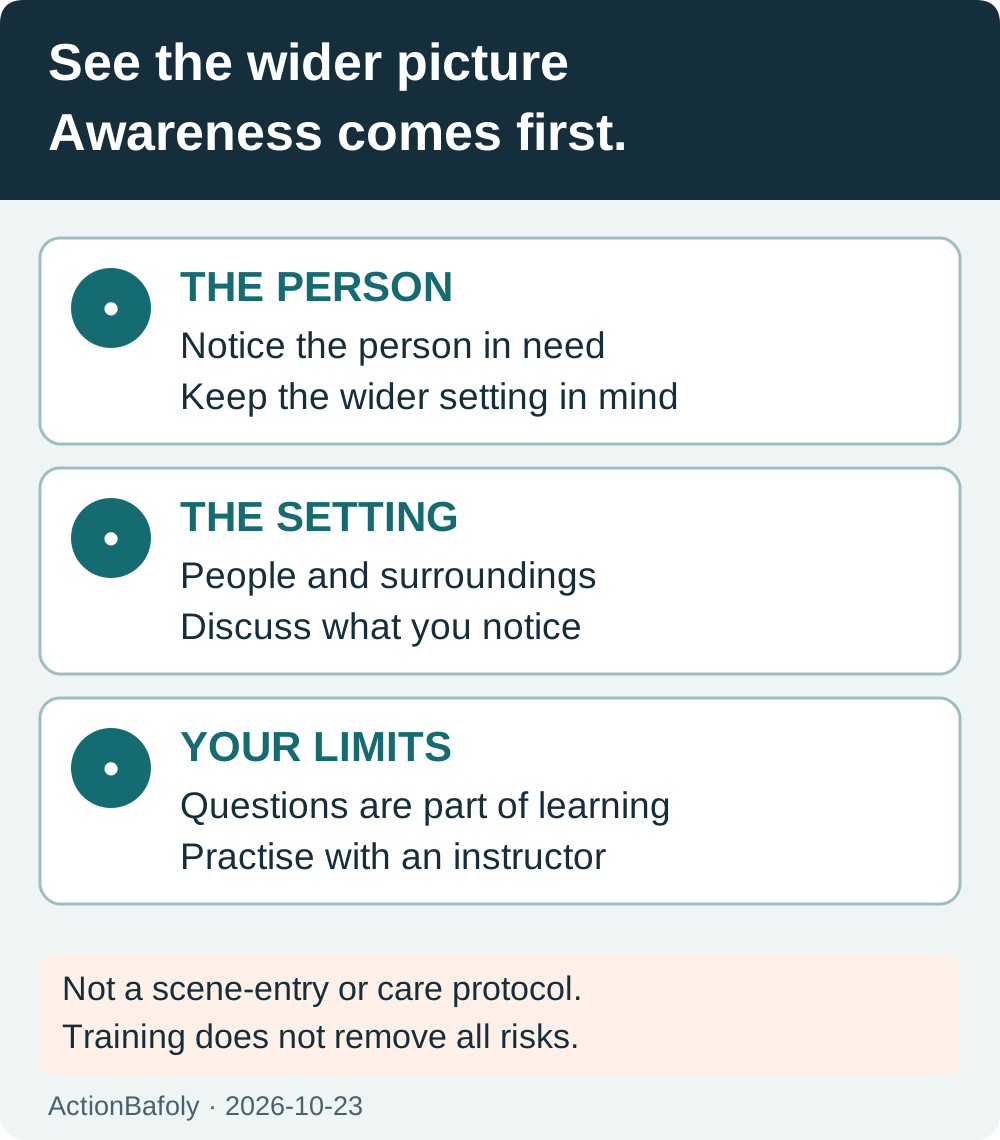
What does scene safety mean in training?
Think of it as making room to notice the whole picture, not just the person who needs help. A learner may be focused on that person while missing the surroundings, other people or the need to get help. An instructor can help learners practise thinking through a response instead of assuming that every situation is safe or that they must handle it alone. A written article is no substitute for that guided practice.
The Canadian Red Cross's current public CPR and AED outline includes “Check, Call, Care” at Level A, and Level C includes Level A content. These are broad public course headings, not a published step-by-step scene-safety lesson or a complete instructor syllabus. [Source 1]
Why does it matter for both people?
A response is not helped by creating another person who needs help. Awareness of one's own safety is therefore part of being ready to help, not an excuse to ignore someone. Training can give people space to ask what they notice, what they do not know and when they need help from others. It cannot make every location safe or guarantee a particular outcome.
Picture a busy community event: a volunteer sees someone in distress, while other people are moving around. The point of the example is not a universal checklist. It is that attention can narrow under pressure. Practising decisions with an instructor helps put the person and the wider setting back in view.
Who benefits from learning this?
Families and volunteers may want to feel better prepared for ordinary community settings. Coaches and workplaces may have additional role-specific needs. They should not assume that one course or certificate meets every organization's rules. If your main need is a workplace or school credential, check the exact course name and acceptance requirements with that organization before booking.
CPR C or Basic/Emergency First Aid and CPR C?
| Public course outline | What the Red Cross actually lists | Useful question before choosing |
|---|---|---|
| CPR and AED Level C | Includes Level A content, with CPR/AED and choking-response topics | Is CPR/AED-focused learning what your role requires? |
| Basic/Emergency First Aid & CPR C | Lists CPR-related topics plus broader first aid content, including wound care | Do you also need broader first aid learning? |
These are public summaries, not interchangeable lesson lists. They do not establish identical scene-safety lessons or a complete ActionBafoly instructor syllabus. The exact instructor lesson sequence, including renewal classes, has not been verified here. The Red Cross notes that Basic/Emergency recertification is not available in all jurisdictions. [Sources 1–2]
ActionBafoly's Basic/Emergency First Aid and CPR C course page describes guided practice in assessing a situation and a person and getting emergency help. It is a local course option, not a promise of an available seat or acceptance for every job. Check the course option and your requirements before booking. [Source 3]
What should you take away?
If you want to be useful in an emergency, ask yourself: Would I recognize when I need help, and have I practised making decisions with an instructor? Awareness and practice belong together. For Montreal-area learners, explore ActionBafoly's first aid and CPR training; choose the course that matches your own requirements. You can also browse the ActionBafoly website and its YouTube channel for general learning content, not real-time emergency instruction. This reading is not a substitute for training or situation-specific emergency guidance.
Sources
- Canadian Red Cross, CPR and AED Course, public course outline; publication date not shown; checked 2026-10-23.
- Canadian Red Cross, Basic First Aid & CPR Course, public course outline; publication date not shown; checked 2026-10-23.
- ActionBafoly, Basic/Emergency First Aid and CPR Level C, course and booking page; checked 2026-10-23.