What is first aid, and why learn it?
You might know where the first-aid kit is. But if someone needs help, would you know what to do next? Learning first aid is less about memorizing a page of instructions and more about practising how to respond within your training. The Canadian Red Cross describes its first-aid and CPR courses as practical preparation for emergencies at home, at work and in the community. This guide helps you decide what kind of learning to explore—not treat an emergency from an article.
What are first aid and first-aid training?
First aid is help given when someone is ill or injured before further help is available. A course gives that broad idea a practical setting: an instructor helps you learn to recognize a problem, seek help and practise relevant skills. The Canadian Red Cross Basic First Aid & CPR outline includes responding to emergencies, CPR and AED use, and wound care. Those headings describe a public course outline, not every lesson in every course or renewal.
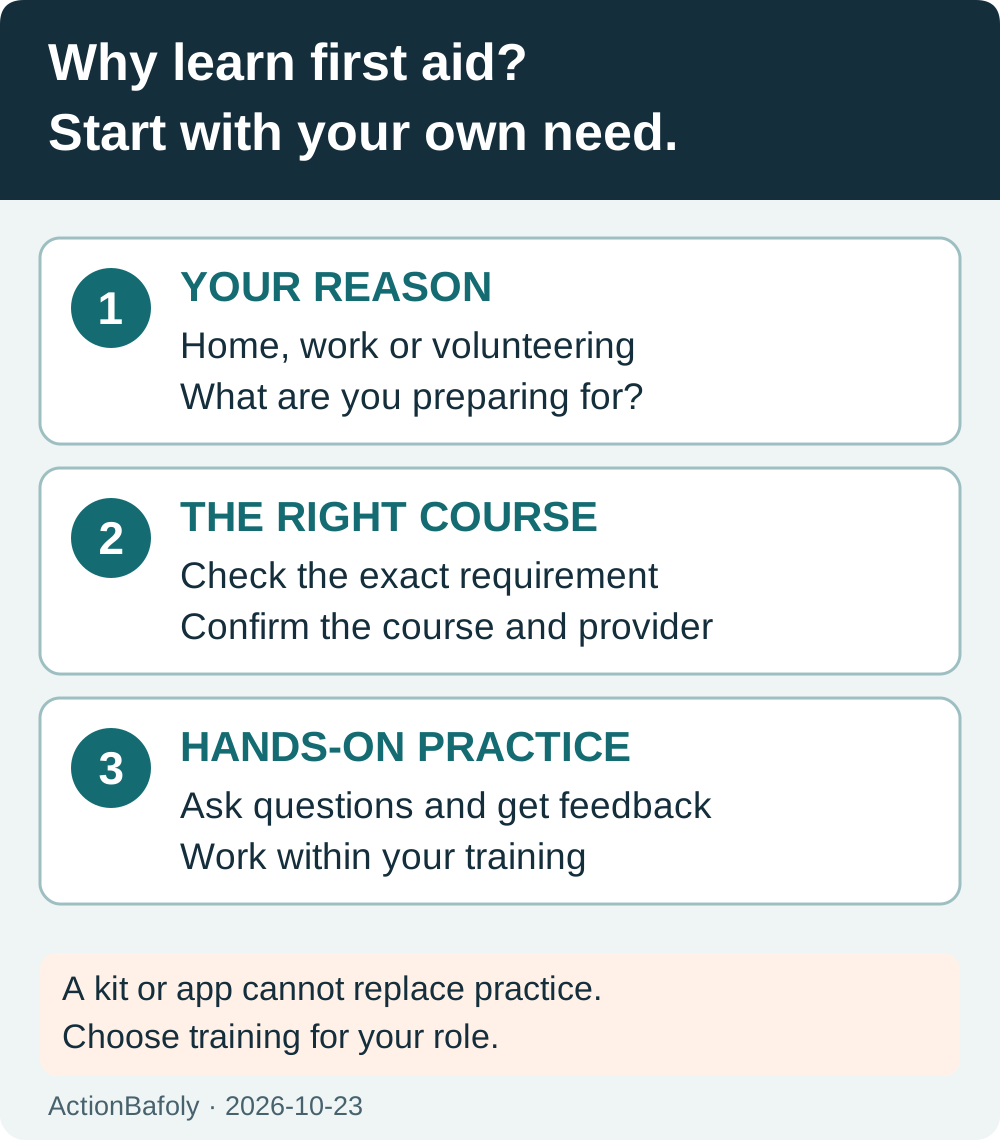
Think of a course as a rehearsal rather than a page of notes. You get a chance to try a skill, ask what you did not understand and receive feedback. The Red Cross's preparation guidance explicitly says its app does not replace hands-on training. A course is not a promise that every emergency will go well; it is a way to prepare for your part in a response.
For a Montréal-based, instructor-guided option that combines first aid with CPR Level C, explore ActionBafoly's Basic/Emergency First Aid and CPR Level C course. Check the exact credential you need before choosing a date.
Why learn before an emergency?
An unexpected event is a poor moment to discover that you have never practised. Training lets you work through questions while an instructor is there, rather than guessing from an app. The Red Cross says its courses develop practical skills for home, work and community settings. That benefit is preparation, not guaranteed confidence, a medical outcome or permission to act beyond your training.
Ask yourself: if a situation changed suddenly, who in your household or group would know the local way to call for help, where the available supplies are and which training they have actually completed? Those are planning questions, not a substitute for live emergency instructions. Emergency numbers and rules depend on where you are.
Who benefits at home, at work and in a community group?
A parent or neighbour may want broad first-aid knowledge alongside CPR. A volunteer might need the course named by an organization. An employer needs to match its training plan to its actual workplace and applicable requirements. The answer is not always the same certificate. The Red Cross course overview offers Basic, Intermediate and CPR/AED options for different needs.
A team can learn together and then make its own role-specific plan. If you are organizing a Montréal group or a group in a community ActionBafoly serves in Eastern Ontario, request a group-training arrangement; the requested date and venue need confirmation. For a workplace, childcare setting or marine role, first check the exact course and credential required by the responsible organization or authority. A general first-aid article cannot establish legal acceptance for your role or jurisdiction.
Does CPR alone cover the same needs?
No—not if the requirement or your learning goal includes broader first aid. CPR Level C focuses on CPR, AED use and choking response; ActionBafoly's Basic/Emergency course includes CPR Level C and broader first-aid learning, including assessment and wound emergencies. The Red Cross Basic course outline lists both CPR/AED and first-aid topics. Intermediate training has additional public topic headings, including sudden medical and environmental emergencies; that does not mean every learner needs Intermediate.
If a workplace or school names a certificate, match its precise name and level instead of assuming a CPR-only or Basic course will count. The same care applies to child-care and marine training: their child-care and Marine Basic outlines have distinct audiences and content. A shared “Responding to Emergencies” heading does not make their lessons or credentials interchangeable.
| Option | Broad focus in the Red Cross public outlines | Question to verify before choosing |
|---|---|---|
| CPR/AED (check the CPR level) | CPR, AED and choking response; scope varies by level. | Is CPR-only training enough for the role or organization? |
| Basic/Emergency First Aid & CPR | First aid alongside CPR/AED, including wound care in the public outline. | Does the requested credential specify Basic First Aid and a CPR level? |
| Intermediate/Standard First Aid & CPR | Broader first-aid outline, including injury, sudden medical and environmental emergency topics. | Is Intermediate required or useful for this specific setting? |
These are learning-focus comparisons, not statements that a course satisfies a particular workplace law or that ActionBafoly offers every option. Ask the organization that sets your requirement which credential it accepts.
Which course, format and credential should you check?
Start with the reason you are learning. Is it personal preparation, a volunteer role or a stated work requirement? Then ask the organization requesting proof for the exact course name and level, acceptable provider, jurisdiction, renewal rule and deadline. Confirm with the provider how much of the course is in person, what practice is required and whether your chosen session is available. Do not assume that a course available online elsewhere is offered in that format on a particular ActionBafoly date.
You can also plan ordinary supplies for your setting. A household kit may be useful, but it cannot replace learning or a workplace-specific assessment; check contents, expiry and local requirements before buying.
How can you start in Montréal?
If Basic/Emergency First Aid and CPR Level C fits your purpose, review the ActionBafoly course options and current dates. Its page describes guided, in-person practice and the Red Cross certificate pathway after successful completion. A listed date is not a guaranteed seat. If another credential is required, verify that requirement first and ask about the appropriate course rather than booking the nearest-sounding option.
First aid is not one universal certificate or a replacement for a local response plan. The useful next step is simple: identify why you need training, confirm which course counts, then practise with an instructor. This article does not replace training or real-time emergency guidance.
Sources
- Canadian Red Cross, First Aid and CPR Courses, undated page, checked 2026-10-22.
- Canadian Red Cross, Basic First Aid & CPR Course, undated page, checked 2026-10-22.
- Canadian Red Cross, Intermediate First Aid & CPR Course, undated page, checked 2026-10-22.
- Canadian Red Cross, Emergency Child Care First Aid & CPR Course, undated page, checked 2026-10-22.
- Canadian Red Cross, Marine Basic First Aid & CPR Course, undated page, checked 2026-10-22.
- Canadian Red Cross, First aid facts over myths: What to do in an emergency, preparation section only, undated page, checked 2026-10-22.
ActionBafoly: website · YouTube channel. Course booking pages are service destinations, not independent evidence of clinical outcomes.