Intermediate/Standard First Aid and CPR Level C: is this the course you need?
A CPR-only course and a broader first-aid course solve different learning problems. If you want to practise what to do across a range of injuries and illnesses—not only CPR—what does Intermediate First Aid add? And if you need a certificate for work, how do you know the course is the right one?
What is Intermediate/Standard First Aid and CPR Level C?
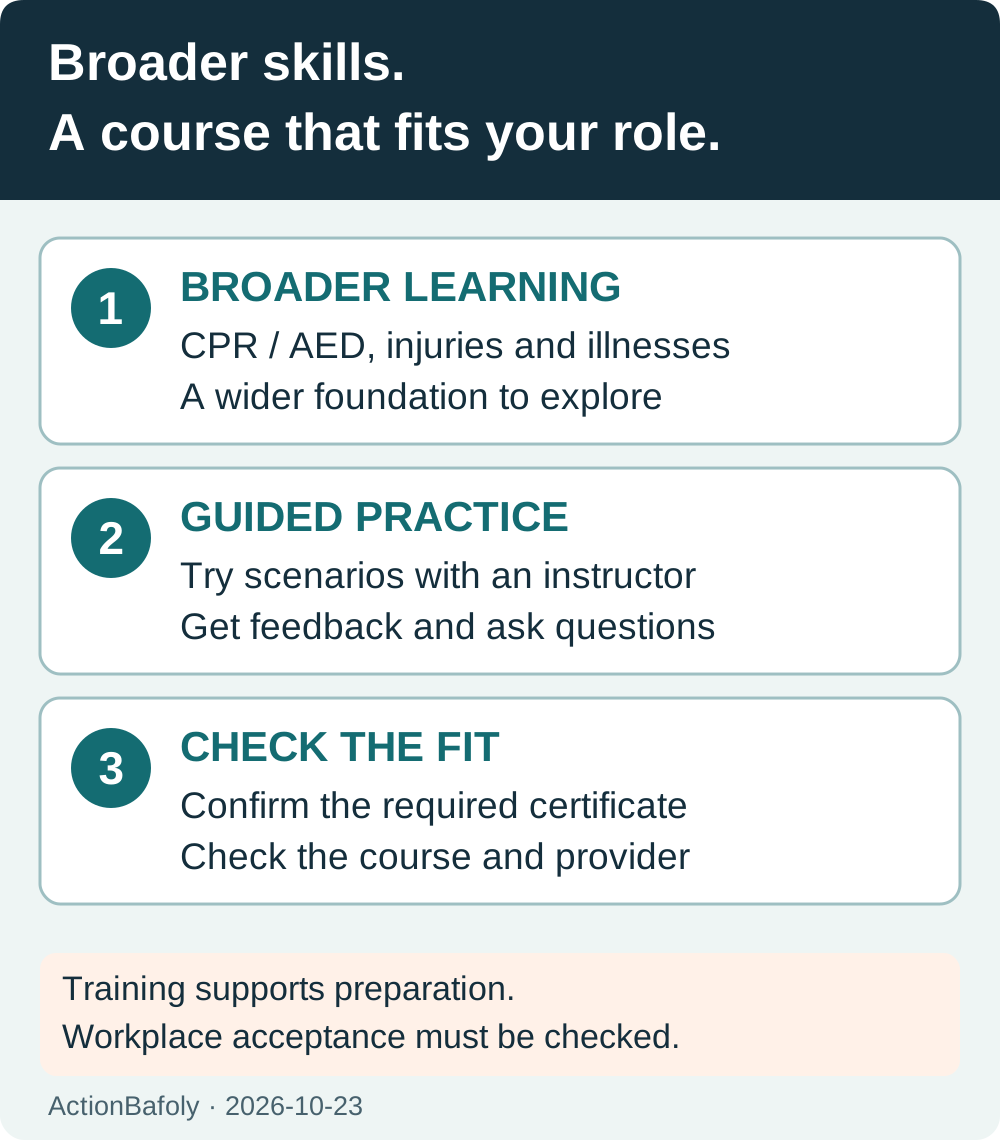
The Canadian Red Cross Intermediate First Aid & CPR course combines first-aid topics with CPR and automated external defibrillator (AED) learning. ActionBafoly offers a local course under the name Intermediate/Standard First Aid and CPR Level C. The full course has no prerequisite according to the Red Cross. This is a course to learn and practise with an instructor, not a substitute for checking the requirements of a particular job or organization.
Think of CPR as one important tool in a larger kit of skills. The broader course gives learners more situations to consider and more chances to put those ideas together. That does not mean a graduate can handle every emergency, or that a certificate is accepted everywhere.
What does it cover—and what does practice add?
The Red Cross public course description lists CPR and AED, wound care, breathing and circulation emergencies, head and spine injuries, bone, muscle and joint injuries, sudden medical emergencies, environmental emergencies and opioid-poisoning awareness. These are broad topic headings, not a complete instructor lesson plan or instructions to treat any condition. In ActionBafoly's course description, learners work through guided scenarios and practise skills with an instructor. The Red Cross requires demonstration of the specified skills and full participation for successful completion.
A list can tell you what is discussed. A supervised practice session gives you a chance to try, receive feedback and ask questions. Neither reading this article nor watching a video replaces that practice. For more general course-related videos, you can explore the ActionBafoly YouTube channel; it is not evidence of any specific course outcome.
Who could benefit, and when should you choose a different path?
An individual who wants a broader foundation, a coach or volunteer preparing for a community role, or a team discussing shared training can consider this course. The practical question is: what are you preparing for? If your employer, association or regulator names a specific certificate, obtain that exact requirement before requesting a class. You can send the requirement with an individual or group training request, but the reply—not this article—must confirm the suitable option.
For a designated workplace first-aider in Quebec, the CNESST describes its own recognized-organization training pathway. Do not treat the ordinary Red Cross course named here as automatic proof of CNESST qualification. Ontario employers should check the WSIB First Aid Program and the applicable provider and certificate rules. Requirements also vary outside these jurisdictions; this Montreal-oriented article is not worldwide credential advice.
What is the value for one person, a workplace or a community group?
For one learner, the value is structured time to learn a wider set of topics and practise with feedback. For a workplace, the value may be a common training experience—but the employer still has to establish which training its obligations require. For a volunteer group, it may help members discuss their roles and preparation without assuming everyone has identical duties. None of those benefits guarantees a particular emergency outcome.
Training is one part of preparation, not a replacement for an appropriate first-aid kit or a site-specific plan. For a team, check what the kit actually contains, what needs replacing and what your setting and applicable rules require. A kit alone cannot make a workplace prepared for every emergency.
How long is it, and what does completion mean?
For the Red Cross Intermediate/Standard First Aid & CPR Level C full course, the published teaching time is 14 hours in class, or 8 hours online plus 7.5 hours in class for the blended format. Minimum teaching time is not necessarily the whole elapsed day. ActionBafoly's live request page lists 14 hours of in-person teaching; its blended full course is something you may ask about, not a confirmed session. It lists a course price, but the final quote and availability are provided in the reply. Avoid planning travel or staffing around an unconfirmed date.
The Red Cross says completion requires demonstrated competency in required skills, at least 75% on an independently completed closed-book written evaluation, full attendance and active participation. Successful learners receive a three-year Canadian Red Cross certificate. Attendance alone does not guarantee certification. Recertification has separate eligibility and scheduling: use the recertification request page if that is what you need.
| Before you request | Check this first |
|---|---|
| Goal | Broad personal learning, or an exact certificate required for a role? |
| Recognition | Ask the employer or accepting authority which course and provider it accepts. |
| Format | Ask whether an in-person or blended full course is available for your requested date. |
| Completion | Allow for participation, practical demonstration and written evaluation—not just attendance. |
| Booking | A submitted request is not a reserved seat or payment. |
What should you do next?
Have the name of any required certificate, number of learners, preferred language, location and timing ready. Then request Intermediate/Standard First Aid and CPR Level C from ActionBafoly. One learner or a group may inquire. The team will reply with availability and a quote; the form itself neither takes payment nor reserves a place. For other local offerings, see ActionBafoly's website.
Sources (independent of any commercial links): Canadian Red Cross, Intermediate First Aid & CPR Course (no visible publication/update date; checked October 22, 2026); CNESST, Formation de secourisme en milieu de travail (no visible date; checked October 22, 2026); WSIB, First Aid Program (checked October 22, 2026). ActionBafoly course request page supplies local offer and request details; it is not independent evidence of regulatory acceptance.