
How do first aid supplies support wound-care readiness?
A first aid kit can be sitting in plain sight and still be hard to use when it matters. Are the wound-related supplies intact? Can someone find the kit? And does anyone know how to use its contents? Those are different questions. This guide is about preparing, not treating a wound in progress.
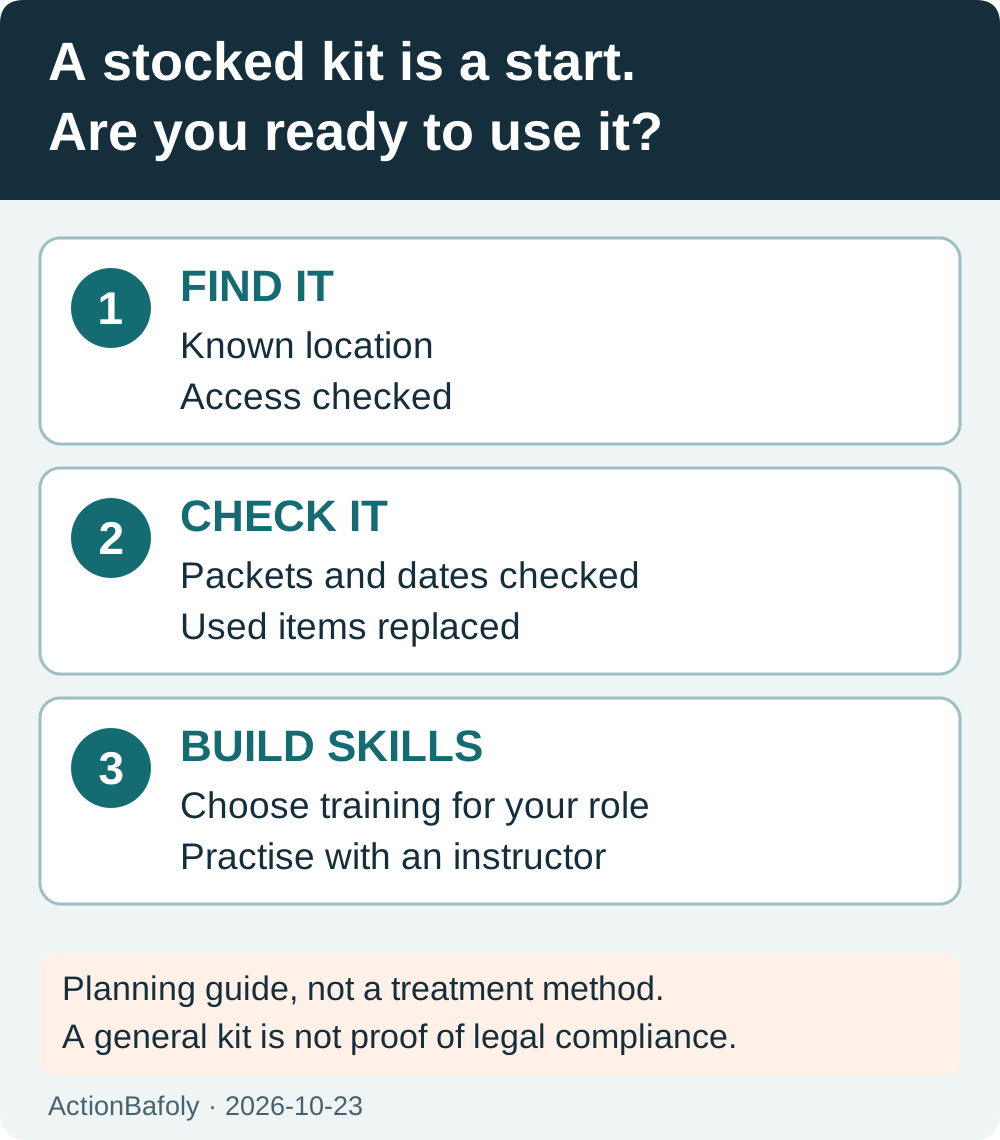
What does wound-care readiness mean?
It means knowing where the kit is, checking its contents, and connecting the supplies to first aid skills. The Canadian Red Cross's general kit guidance names sterile gauze dressings, adhesive tape, bandages and disposable non-latex gloves among its supplies. This is a starting point for a general kit, not a complete prescription for every setting. Canadian Red Cross kit guidance.
A dressing and a bandage are not interchangeable words for an entire response. The Red Cross describes gauze pads as dressings that go over wounds, and lists tape and several bandage types separately. Gloves are another listed item. Having these materials ready can support a trained response; merely owning them does not establish that someone knows what to do. We are not offering a wound-treatment method here.
Why check the kit before it is needed?
Picture reaching for a packet and finding it damaged, or discovering that the last gloves were never replaced. The Red Cross advises keeping a kit dry and accessible, checking it every six months, replacing expired, damaged or contaminated items, and restocking after use. A short check before an activity can reveal an avoidable supply gap. Canadian Red Cross kit guidance.
For a household, that may mean making sure the people who need the kit know where it is. For a group organiser or team custodian, it may mean assigning someone to check access and replenishment. These are planning examples, not claims that a general kit meets a workplace or childcare rule.
| What to check | Why it matters | Where to verify |
|---|---|---|
| Can the people who need the kit find and access it? | A kit cannot help if no one can reach it. | Check its actual location and who has access. |
| Are wound-related packets sealed and contents intact? | Damaged or contaminated items may need replacement. | Inspect your kit against the Canadian Red Cross general kit guidance and product labels. |
| Has the kit been checked and restocked? | Supplies can expire or be used up. | The Canadian Red Cross advises a six-month check, replacement of expired, damaged or contaminated items, and restocking after use. Check the kit record and contents. |
| Who has practised first aid? | Supplies are not a substitute for skills. | Ask the people involved about their training; confirm the course matches their role. |
| Does this role or activity have specific requirements? | A general list does not establish legal compliance. | Consult the applicable workplace, childcare, marine or other authority; do not assume this table is a mandated checklist. |
Who benefits from supplies and practice?
Individuals, caregivers, volunteers and teams can all ask the same question: who has practised first aid, rather than only seen the contents of a kit? The Canadian Red Cross publicly lists “Wound care” under Basic/Emergency First Aid and CPR, Intermediate/Standard First Aid and CPR, Emergency Child Care First Aid, and Marine Basic First Aid. These are broad course headings; they do not tell us the exact lesson sequence or which individual supplies an instructor teaches in each full or renewal class. Basic/Emergency course · Intermediate/Standard course · Child Care course · Marine Basic course.
For one person, guided practice offers a way to build skills beyond reading a checklist. For a workplace or community group, knowing who is trained and who maintains the kit makes the plan more usable. Training and a stocked kit serve different purposes; neither promises a particular outcome in an emergency.
Does a general list satisfy my workplace or activity's requirements?
Not necessarily. A Red Cross general-purpose kit list is not proof of compliance for a particular Quebec or Ontario workplace, childcare setting, federally regulated role, or vessel. Check the applicable authority and the exact role or activity before choosing a required kit or course. Do not assume that one certificate is accepted everywhere. Likewise, a public “Wound care” heading is not a verified inventory of ActionBafoly's instructor lessons.
If someone needs urgent help, use the local emergency service. This planning article is not a substitute for emergency assessment, first aid instruction or medical care.
What is a useful next step?
Check where your kit is, whether the listed wound-related supplies are intact, and who can access and replenish them. Then match your training to your own role and jurisdiction. In Montreal, ActionBafoly offers Basic/Emergency First Aid and CPR Level C with instructor-guided practice. The course page includes wound emergencies and full-course or eligible recertification options; check your eligibility and the current booking choices rather than assuming a seat or universal recognition. For more ActionBafoly first aid content, visit the ActionBafoly YouTube channel. Explore other local courses at ActionBafoly.
Sources and scope
- Canadian Red Cross, First Aid Kit Contents: What to Include for Home, Car & Outdoors, undated page, accessed October 22, 2026.
- Canadian Red Cross course descriptions: Basic/Emergency, Intermediate/Standard, Emergency Child Care, Marine Basic, undated pages, accessed October 22, 2026.
- ActionBafoly, Basic/Emergency First Aid and CPR Level C booking page, undated page, accessed October 22, 2026. Booking and eligibility are subject to the live page.