
Before a young babysitter says yes: who agrees to what?
A family asks a young person to babysit for the evening. The hours sound clear—but what if the family later asks them to stay longer or take on a task they have never done? Responsibility starts before the yes: both sides say what they expect and what they will do if the plan changes.
What does the course say about responsibility?
The Canadian Red Cross Babysitting course names responsibility and leadership as a broad course topic; its public overview does too. Neither public outline describes a separate leadership lesson or credential. The conversation below is an editorial family exercise, not prescribed Red Cross coursework, a legal checklist or an emergency protocol. A 2016 Red Cross personal account mentions asking questions before accepting a job; that anecdote is not evidence that these specific prompts are taught or improve safety.
What should each side settle before accepting?
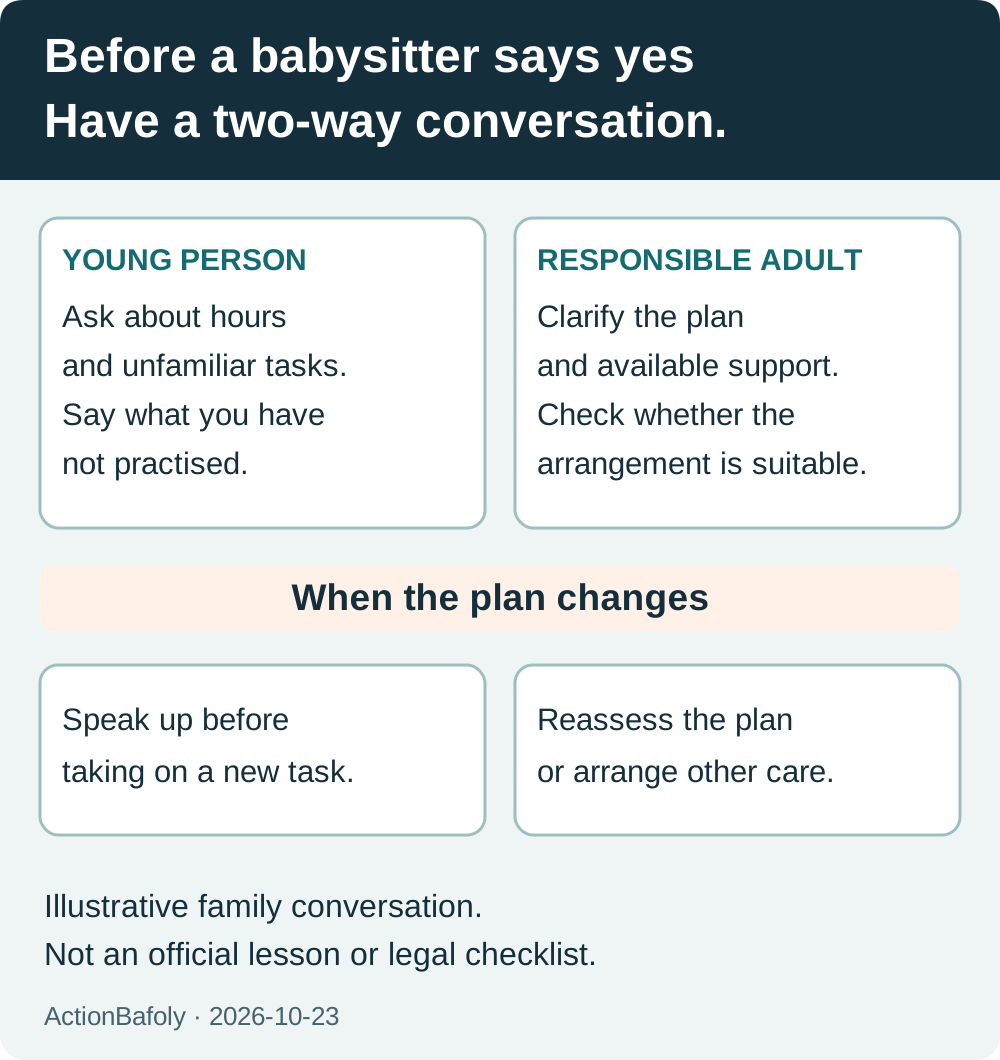
Instead of “Can you babysit?”, try a two-way conversation. The adult remains responsible for deciding whether the arrangement suits the child and the young person; the prospective sitter can answer honestly about their preparation. For example:
| Moment | Prospective sitter could ask or say | Responsible adult could clarify |
|---|---|---|
| Before saying yes | “What time will you return? What would you like me to do? I haven't done that task before.” | “Here are the agreed hours and tasks. Let's change the plan if a task is beyond your preparation.” |
| Agreeing on support | “Who can I reach if something changes? What if I can't reach that person?” | “Here is the adult responsible for this arrangement and how we will communicate. Let's make another arrangement if support is not workable.” |
| A new request arises | “This wasn't part of our agreement. Can we discuss it before I take it on?” | “Don't assume the new task is accepted; we'll decide together whether to change the plan or arrange another caregiver.” |
| After the assignment | “What worked, and what should we agree differently next time?” | “Let's review the agreement with you rather than assume you were comfortable with every change.” |
These are illustrative questions, not instructions to leave a young person alone with an unsuitable task. They deliberately avoid a child's private details and do not replace a family's own contact and safety arrangements. A plain note kept by the responsible adults can hold agreed information; buying a product is unnecessary.
Why isn't leadership the same as doing everything alone?
In that example, speaking up about an unfamiliar task is useful follow-through, not a failure. If the request changes, the adult must assess the arrangement again; the young person should not be expected to pretend they know more than they do. The closing conversation makes the next agreement clearer. None of this guarantees a safety outcome or substitutes for guided practice.
Who is this for, and what does the course certify?
A prospective sitter and family can use the example; a school or community group could adapt it for a discussion. These are potential uses, not measured benefits. The Red Cross describes its Babysitting course for ages 11–15. Its published entry condition is at least age 11 or completion of Grade 5, and its duration is 7–8 hours. It lists a Babysitter Completion Certificate, not CPR-C certification or a professional childcare qualification. Check provincial rules and the requirements of the specific role separately; course entry and completion do not prove suitability for a job.
An adult may ask ActionBafoly about its in-person, by-request Babysitter course in the Montreal area. The request takes no payment and does not reserve a seat; ActionBafoly replies with availability and a quote. See the ActionBafoly site or YouTube channel for other training information. Training complements—not replaces—the family's agreement, adult support and applicable local requirements.
Sources
- Canadian Red Cross, Babysitting Training, undated public course page, checked 2026-10-23. Course topics, prerequisite, duration and certificate.
- Canadian Red Cross, Babysitting public course overview, undated document (January 2025 appears in URL), checked 2026-10-23. Same issuer and broad topic heading.
- Canadian Red Cross, Adventures in babysitting, January 25, 2016. Dated personal account, not a current syllabus or effectiveness study.
- ActionBafoly, Babysitter course inquiry, undated, checked 2026-10-23. Local request destination, not independent credential evidence.