
Why practise decisions and handling difficult behaviours before babysitting?
A child refuses the usual activity, and the young babysitter is unsure what the family expects. The useful question is not “How do I make the child obey?” It is: What have the family and sitter agreed the sitter can decide, and when should the sitter call an adult?
What does the course cover?
The Canadian Red Cross Babysitting course lists “how to make good decisions and manage difficult behaviours” among its public course topics. It also names responsibility, leadership and safer choices. This is a broad course outline, not a published list of individual instructor lessons or a promise that one technique works for every child.
Why discuss difficult behaviour before a visit?
A child may be frustrated, tired or upset; the sitter cannot know why from a brief encounter. The Public Health Agency of Canada’s parent-facing guidance discusses staying calm, understanding feelings and distinguishing a child's feelings from unacceptable behaviour. That PHAC parent-facing guidance (page last modified March 5, 2018) is context for adults, not a Red Cross method or a discipline script for youth sitters.
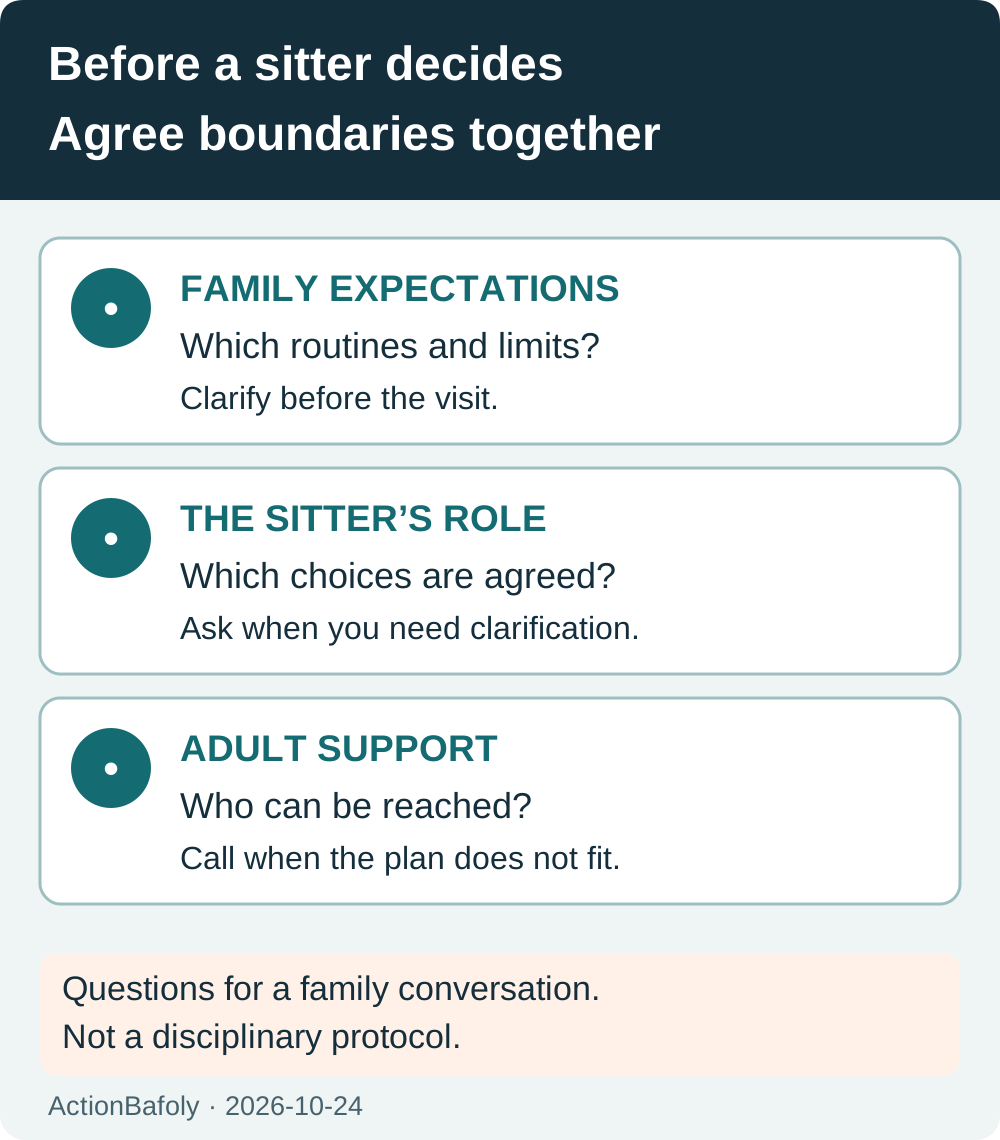
The practical starting point is a conversation with the family. What routines and limits should the sitter follow? Which choices may the sitter make? How can the sitter reach the responsible adult if the agreed plan does not fit? Asking beforehand is better than assuming the young sitter must handle every conflict alone. This is not emergency-care advice; situations outside the sitter's agreed responsibility need adult support.
Who decides what is within the sitter's role?
The family sets expectations for its child; the sitter can ask for clarification and say when a situation is beyond their comfort or agreed responsibility. These are discussion prompts, not a disciplinary protocol:
| Ask the family before the visit | Clarify the boundary |
|---|---|
| What are the usual routines and household limits? | Which choices may the sitter make without checking first? |
| How does the family prefer to be contacted? | Who is the responsible adult to contact when a situation goes beyond the plan? |
| What would the family want explained after the visit? | What information should remain private? |
A parent, guardian or adult organizer can ask ActionBafoly about its Montreal Babysitter training as a guided way to discuss decisions and communication. The course does not replace the family-specific conversation.
Who is this for, and what does the certificate mean?
A prospective young sitter may gain a clearer way to ask for help. A family can make expectations explicit. A school or community group can discuss responsibility without pretending that a young learner is a professional childcare provider. The Red Cross lists a Babysitter Completion Certificate for its youth course; it is not CPR-C certification or proof of professional childcare qualification. Check the particular role and local rules separately rather than assuming universal acceptance.
What is the next step?
Before an assignment, can the family and sitter each explain the plan for an everyday disagreement—and name the adult the sitter can contact? If not, make time to talk. An adult can request the Babysitter course in Montreal; the page describes eligibility as age 11 or older or completion of Grade 5. Sending a request does not pay for or reserve a seat. Provide the adult's contact details and a learner age range, not children's full names or private information. For other training, visit ActionBafoly. For more general first-aid content, explore the ActionBafoly YouTube channel; videos do not replace hands-on training.
Sources
- Canadian Red Cross, “Babysitting Training,” undated public course outline: Read source
- Public Health Agency of Canada, “Behaviour: Stay Calm and Connected,” last modified March 5, 2018 (parent-facing): Read source
- ActionBafoly, “Babysitter in Montreal,” undated request page: Read source